


Baddersly Clinton
a scruffy ruffian
Baddersly Clinton
I write music all the time. I always have a song that I am working on, usually a few. They bounce around from piano to guitar for a week or so, sometimes getting caught by Logic Pro, before scuttling off to die with all the others. I always intend to go back to them and “finish” them, but I am a terrible finisher it seems. In the last 7 years I have “finished” 10 songs, despite having started ten times that.
There are a lot of things that hold me back from sharing songs more often than I do. I am scared of what people with think of the things I share. I’m scared that they aren’t worth sharing.
The curios thing is that despite feeling like this I still feel compelled to share something. I don’t understand what this is exactly. It seems somehow not enough to just write music for myself. Maybe I’m looking for validation. Maybe the fact that I find it scary is also what compels me. However, if a fear of failure prevents me from sharing then haven’t I already failed?
It also struck me recently that no one is listening. Who are these people who I am worried about judging me? They exist only in my head.
I think about my songs a lot more than anyone else. I think about every aspect of it and how it can be improved. And yet for all this I am not convinced the end result is any better than the song was when it was born.
In this spirit I am sharing this song, which is very unfinished. Here are the things I don’t like about it:
However, I won’t have time or inclination to fix these things before I move on to another song, so here it is. No one is listening anyway.
We are sadly parting ways from Scruff, our faithful campervan. We are expecting a new addition to the family, and Scruff only seats and sleeps four, so he needs a new family to serve:


We have really loved owning this van. It has given us lots of pleasure and many cheap holidays. I am sure its new owner will get just as much joy from it.
Make: Volkswagen
Model: Transporter (T4)
Conversion: Autosleeper Trident
Miles: 126k (ish)
Fuel: Petrol
The van has a working Fridge, Cooker, Sink, and running hot water. There is also a leisure battery (18 months old) for running the lights and the pump for the tap. I am including the cable for the electric hookup so you can also run 240V power inside the van.
This model is pretty unchanged from the original conversion.
If you’re interested pleased get in touch.
Sister Corita Kent‘s 10 Rules for Students and Teachers, made famous by John Cage, states:
RULE EIGHT: Don’t try to create and analyze at the same time. They’re different processes.
This was a revelation to me.
So often when we try to create we judge what we are making before its even had a chance to breathe and grow. I see this all the time with my children, who are too scared to try anything new for feat that they will do it wrong. We all seem to have this tendency to analyse and deconstruct any creative work we are doing at the same time that we are doing it.
To me this rule is a useful reminder to enjoy the creative process more. To be comfortable making mistakes (although according to rule 6 these don’t exist), to play with ideas and see where they take me. I hope that this attitude will allow me to be more confident in sharing what I made without fear of it being judged. I encourage you to do the same.
In April last year we began work on a new product to sell .blog domains. We just open sourced this project. Check out the announcement from my friend and team-mate, Stéphane Thomas.

This was a really fun project to work on. We worked very closely with a team of designers to trial some new product concepts (like passwordless signup), and were able to experiment with some interesting new technologies (like CSS modules). I am really proud of the things we achieved together. I believe that this is an great demonstration of how a team is greater than the sum of its parts.
If you want your own .blog domain, then take a look at get.blog.
For thousands of years humans have been communicating in two main ways, spoken word and written word. Spoken word is generally real time and responsive – one person speaks, another responds; a conversation. Written word is usually delayed, and long form – someone will write a letter or an email, and the response will come hours or days later. Over time many conventions have been established in these communication channels – we read body language, tone, expression, and many other subtle cues in the message. This is harder to do in written communication, but the cues are still present.
In the last few decades these two communication channels have merged in the form of text based chat. Text chat is written communication, but its short form and often real time. It also has subtle cues that can be inferred, which I have dubbed “subtext”. Many of these cues are lost when the conversation is read back. Some examples include:
Like all implicit communication it is important to treat these cues with caution. There are many other plausible explanations for the behaviours listed above. Just as with spoken and written communication clarity is important; if the “subtext” of your chat is conflicting with the content of the chat then it is probably best to make your concerns explicit, so that the implicit cues are not being read incorrectly and causing confusion.
What other kinds of “subtext” can you think of?
I’ve been playing with a vocoder quite a lot so I recorded a christmas carol:
This blog has a new address: ben.blog.
Also, my daily haiku site has a new address: haiku.blog.
I am part of the team behind get.blog; a place to get your own .blog address; come visit if you’d like one.
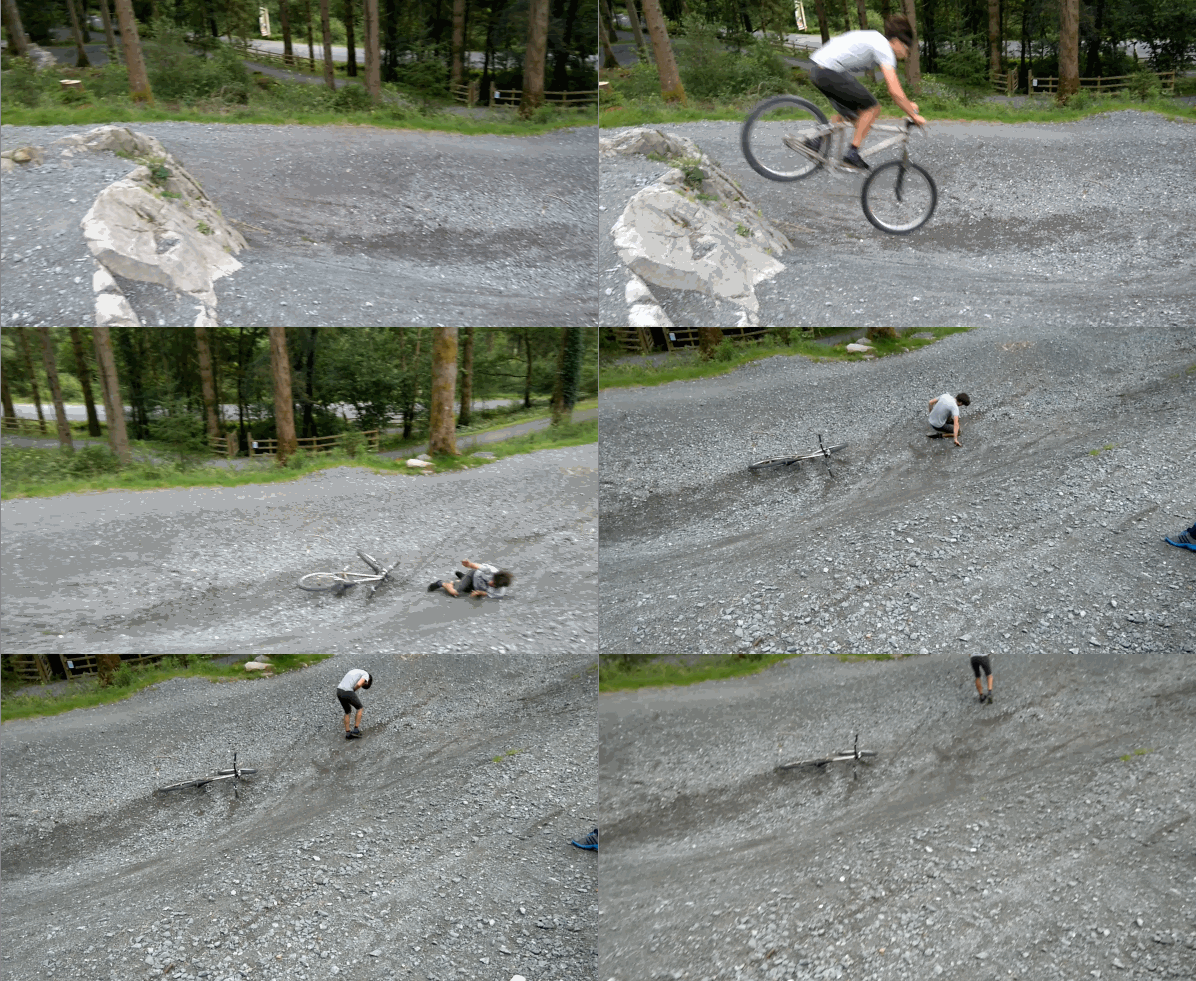
If you watch the video carefully you can see that I am already off the ground at the point where I enter the frame.


